
Car Calendar
Receive notifications about upcoming cars
No account yet?
What you get with a free account
- Follow the premieres of the cars you care about – all in one place
- An e-mail when a car you follow is revealed
- Follow more premieres with a single click
- Free and no spam
Already have an account?








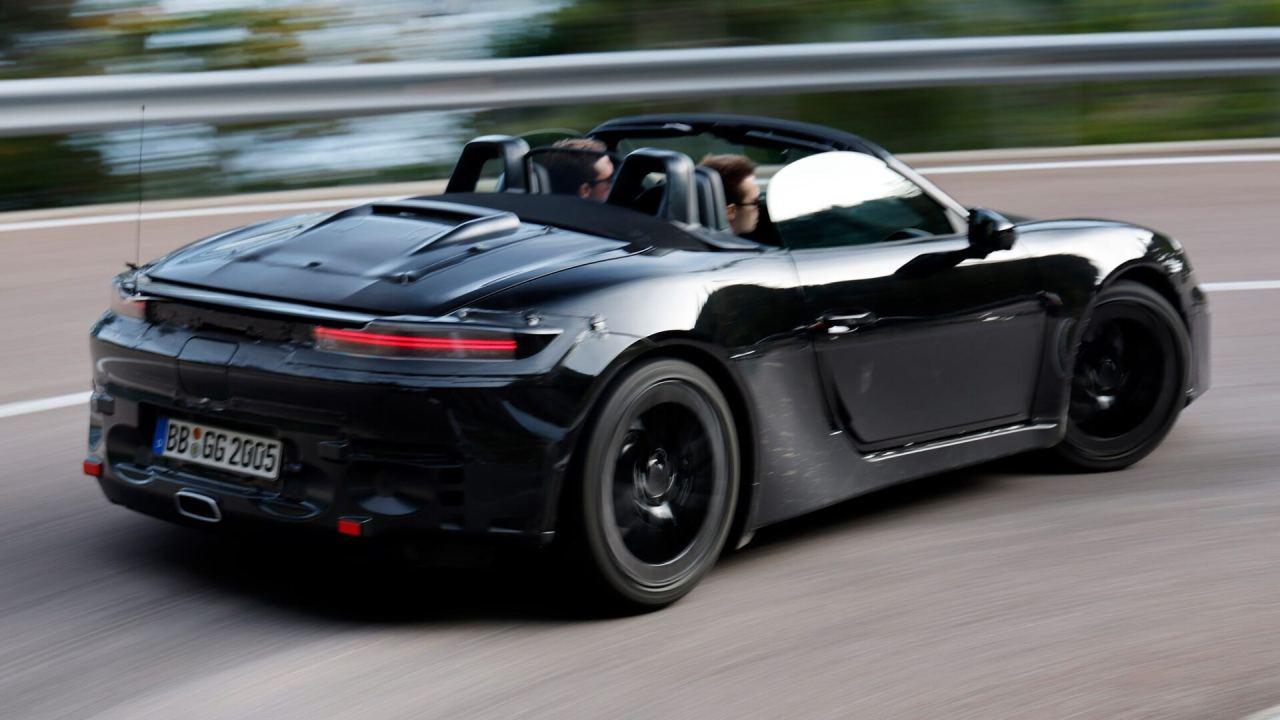
Porsche Boxster
Technical description:
Model: Boxster
Battery Technology: cylindrical cells
Range: 20% more than current models
Charging: 50% faster
Material Costs: 15% lower
Don't miss the Porsche Boxster reveal
Leave your e-mail and we'll let you know about the premiere and new details on this model.
Next, you'll create a free account. No spam.
What's new
The next-generation electric Porsche 718 Boxster is being developed to simulate downshifts, complete with a response that recalls a flat-six throttle blip. A prototype demonstrated during a passenger ride at Porsche’s Weissach test facility does not use a conventional gearbox, yet its E-shift system is meant to make occupants physically feel a gear change. That is the central idea behind a car designed to carry familiar Boxster sensations into an electric drivetrain.
During the ride, the prototype reportedly felt like a regular Boxster, which Porsche appears to treat as the highest compliment. The battery pack is positioned behind the seats to mimic the mass distribution of a mid-engined sports car. Porsche calls the layout E-Core, and it is intended not only to preserve balance but also to keep the low seating position Boxster drivers expect.
The new Boxster will form part of the next-generation 718 family together with the hardtop Cayman. The car is still at prototype stage, with camouflage and secrecy surrounding the exterior. As a result, the clearest message came not from the bodywork but from the way the drivetrain, sound and simulated shifts behaved on the test run.
Specifications and technology
E-Core, E-shift and synthetic sound
The key technology is E-shift, Porsche’s system for simulating gear changes in an electric car. Instead of cutting torque for a moment and creating a pause, Porsche uses a split-second overboost so the transition can be felt through the body. According to the passenger ride, the system can mimic both upshifts and downshifts, even though the driver knows there is no mechanical transmission underneath.
The artificial exhaust note is said to channel the GT3’s high-revving flat-six. Porsche is not hiding the fact that the electric roadster is wearing the acoustic costume of a combustion car. The broader concept is to combine a silent electric drivetrain with responses normally associated with an analogue sports car.
The E-Core arrangement places the battery behind the seats, where it can reproduce some of the weight-distribution effect of a mid-mounted engine. The extra mass of the battery reportedly helped grip during the run at the test facility. The professional driver noted instant torque for quicker launches, controlled behavior over rumble strips and strong brakes under hard pedal input.
- battery placed behind the seats in the E-Core layout,
- E-shift system simulating upshifts and downshifts,
- split-second overboost instead of a momentary torque cut,
- artificial sound inspired by the GT3’s high-revving flat-six,
- new cylindrical cell technology planned for the electric Boxster and Cayman.
Michael Steiner, Porsche’s deputy chairman and board member for research and development, gave three figures for the new cylindrical cells. The technology is claimed to deliver roughly 20 percent more range and 50 percent faster charging than Porsche’s current EV lineup, without adding weight. Materials costs are said to be down by 15 percent, a relevant point for a car that still has to move from prototype form to production.
| Parameter | Value |
|---|---|
| Model | Next-generation Porsche 718 Boxster |
| Body style | Roadster |
| Drivetrain | Electric |
| Battery | E-Core layout behind the seats, new cylindrical cells |
| Range | Roughly 20 percent more than current Porsche EVs |
| Charging | 50 percent faster than Porsche’s current EV lineup |
| Materials costs | Down by 15 percent |
Markets, prices and availability
Debut of the new 718 family
The electric Boxster and its hardtop sibling, the Cayman, are expected as part of the next-generation 718 family. The planned debut window is late 2027, because the cars are expected to be unveiled late next year relative to the date of the report. Production is still more than a year away, so the current vehicle remains an early prototype.
Porsche has not given prices, sales markets, trim levels, power output, battery capacity, exact range, acceleration or top speed. What is clear is that Porsche wants the production car to do more than accelerate like an EV; it also wants it to deliver sensations close to a combustion Boxster. That explains the focus on simulated ratios, the physical transition between shift points and a sound profile drawn from a flat-six.
The ride took place at Weissach with a professional driver at the wheel and a journalist in the passenger seat. That setting matters, because the car has not yet been shown in finished form and a factory-run passenger ride is not the same as a full road test. Even so, Porsche has shown its direction: the electric Boxster is not being tuned to leave the combustion sports car experience behind, but to reconstruct parts of it through software, mass placement and drivetrain calibration.
Verdict
The Porsche 718 Boxster EV is being built around a deliberate contradiction: no combustion engine and no gearbox, but responses meant to evoke both. The core facts are the E-Core battery position behind the seats, E-shift with physically perceptible changes and cells claimed to bring more range and faster charging. If the production version keeps those qualities, its late 2027 debut will be a major test for Porsche’s electric sports cars.
Frequently asked questions
When is the Porsche Boxster premiere or reveal?
In the CarsUpcoming calendar, the Porsche Boxster premiere is listed for autumn 2026, with an indicative date of 1 September 2026. Porsche has not confirmed a final reveal date, and the expected debut window for the new 718 family is late 2027.
When will the Porsche Boxster go on sale in the UK?
The UK on-sale date for the Porsche Boxster has not been announced. No Europe-wide sales timing has been confirmed either.
How much will the Porsche Boxster cost?
The price of the Porsche Boxster has not been announced in the UK or in any other market. Porsche has also not confirmed trims, production specifications or a price list.
Should I wait for the Porsche Boxster or buy the current model now?
Waiting makes sense if you want the electric Boxster with the E-Core battery layout, E-shift simulated gear changes, new cylindrical cells, around 20% more range and 50% faster charging than Porsche’s current EVs. A full comparison with the current model is not possible yet because power, battery capacity, performance figures and production pricing have not been announced.
What powertrain and technology will the Porsche Boxster have?
The next Porsche Boxster will be an electric roadster with its battery placed behind the seats in the E-Core layout. It will also use E-shift to simulate upshifts and downshifts, plus artificial sound inspired by the GT3’s high-revving flat-six.
Create account
What you get with a free account
- Follow the premieres of the cars you care about – all in one place
- An e-mail when a car you follow is revealed
- Free and no spam
Log-in
Please log-in to subscribe!