
Car Calendar
Receive notifications about upcoming cars
No account yet?
What you get with a free account
- Follow the premieres of the cars you care about – all in one place
- An e-mail when a car you follow is revealed
- Follow more premieres with a single click
- Free and no spam
Already have an account?








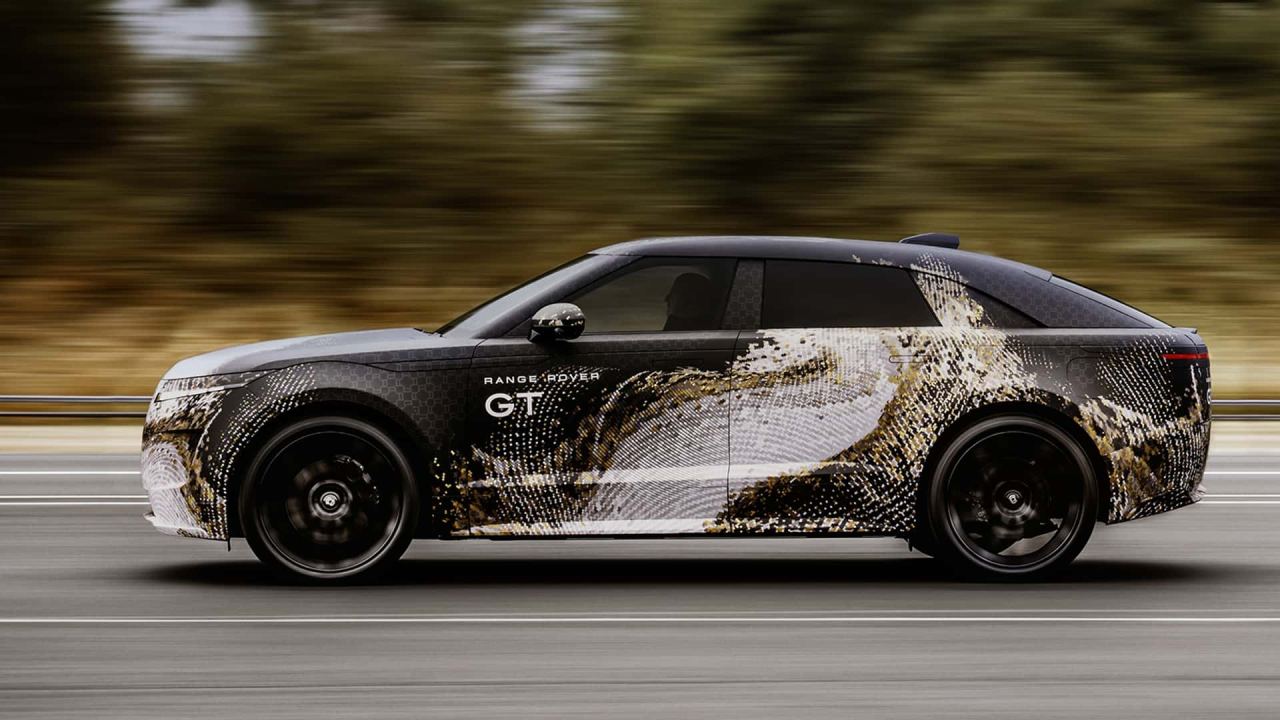





Land Rover Range Rover GT
Technical description:
Model: Range Rover GT
Body Type: Coupe
Drive: Electric
Power: 542 HP
Torque: 850 Nm
Battery: 100+ kWh
WLTP Range: 500 miles
DC Charging: 800 V
Expected Premiere: 2027
Don't miss the Land Rover Range Rover GT reveal
Leave your e-mail and we'll let you know about the premiere and new details on this model.
Next, you'll create a free account. No spam.
What's new
The Range Rover GT will become the fifth model in the brand's line-up and its first low-slung electric four-door coupe of this type. It is due to go on sale in 2027 alongside the existing range and the all-electric Range Rover and Range Rover Sport. The GT name defines its role: a long, spacious and sleek grand tourer positioned away from the brand's familiar two-box SUV shape.
The fastback silhouette marks a clear change in Range Rover proportions. The sharply angled windscreen flows into a roofline that drops just after the centre of the rear wheel, while the rear screen is set at a steeper angle than the Velar's. A tapered rear end is intended to help aerodynamic efficiency and range, and the contrast between the narrow glasshouse and deep body sides gives it a coupe-SUV stance.
The cabin has also been shown, with a dashboard dominated by straight horizontal lines. A subtle full-width air vent runs across the centre, above a shelf lit by ambient lighting and inspired by an upright piano lid. The flat dash top is upholstered in fabric, a porous material that allows sound from a hidden central speaker to pass through.
There are very few physical buttons beyond those on the steering wheel and the usual armrest switch pack. The central OLED display measures 13 inches and is 17mm thick, backed up by a digital driver's binnacle and a standard Head-Up Display. Instead of duplicating the same information everywhere, the system will prioritise content on the display best suited to each function.
- The rivals named for this model are the BMW iX3 and Volvo EX60.
- Three interior combinations are planned: a dark single-tone cabin, a lighter grey cabin and a duotone flagship specification.
- Rear seating will be offered either as a sporty four-seat layout or as a conventional five-seat bench.
Specifications and technology
Under the body, the GT will introduce JLR's Electric Modular Architecture, described as an electric-first platform. EMA is intended for medium-size vehicles and will underpin the GT at launch as a pure EV. A hybrid has returned to the product plan, but it will not be ready for the car's 2027 launch and is expected no earlier than 2028.
Much of the hardware, including the battery, electric drive units, thermal management system and software, comes from the larger Range Rover Electric and Range Rover Sport Electric. The prismatic cells are ultimately set to come from Tata's Gigafactory in Bridgwater, Somerset. Their cell-to-pack layout removes some of the battery framework, reducing weight and cost while allowing more cells to be fitted into each module.
Battery, range and charging
EMA can accommodate a battery of up to 120kWh, housed in a single-layer tray between the wheels. The pack is quoted at 736kg, which will also lower the centre of gravity. With a battery in excess of 100kWh, the GT is aiming for around 500 miles of range, helped by careful aerodynamics and a one-pedal driving mode to maximise regenerative braking.
The electrical system will run at 800 volts. Peak DC charging is expected to be around 350kW, with a 10-80 per cent charge targeted as close to 20 minutes as possible. The launch car is set to use all-wheel drive, in keeping with Range Rover's emphasis on breadth of capability on and off the road.
JLR developed the electric motors in-house after spending 18 months looking for suppliers that could combine low-speed off-road control with high on-road efficiency. The Electric Drive Units use permanently excited synchronous motors and silicon carbide inverters. In the larger Range Rover Electric, one EDU drives each axle for a combined 542bhp and 850Nm; those outputs are not ruled out for the GT, although lower-powered versions are also expected.
| Parameter | Value |
|---|---|
| Platform | Electric Modular Architecture |
| Battery | up to 120kWh, 736kg pack |
| Range | target around 500 miles |
| DC charging | around 350kW |
| 10-80% charging | as close to 20 minutes as possible |
| Drive | all-wheel drive |
Terrain Response will tune the drivetrain and chassis for sand, grass, gravel, snow and rock crawling. The large Range Rover Electric is designed to wade to the combustion car's 900mm depth, and that capability is used as the reference point for the brand's electric development programme. Integrated Traction Management can detect and remove slip 100 times faster than a mechanical system.
Markets, prices and availability
The GT is scheduled to go on sale in 2027, with production planned to start in the first half of 2027. It will be assembled at the upgraded Halewood plant on Merseyside, on the same line as the Evoque and Discovery Sport. JLR has invested £250million in Halewood, adding a new electric body assembly building and adapting trim and paint lines for a roughly 4.8-metre SUV.
EMA body assembly will use robots to fit doors and glass panels for precise panel gaps. Battery installation will be closely managed because the pack's mass could otherwise affect alignment. The paint shop has also been expanded to handle more contrasting roof colours.
Price, versions and passenger space
The current Velar, offered with petrol, diesel and plug-in hybrid engines, starts from around £57,000. The electric GT's price has not been confirmed, but a figure above £70,000 is expected. Exact performance figures, final trim levels and a full market list have not been announced.
The rear cabin has been designed around grand-tourer space. Eight inches of kneeroom is quoted, and Range Rover says the GT is more spacious than the BMW iX3 or Volvo EX60. The largest panoramic roof in Range Rover history is not said to compromise headroom, while the semi-circular roof pod tapers above the fifth seat to avoid intruding into passenger space.
In the four-seat configuration, a rear central armrest folds down with a screen controlling seat heating, cooling and rear climate functions. The extended front centre console, called the bridge, has a translucent sliding cover over twin wireless phone chargers, and the idea is repeated in the rear tray. In the five-seat layout, the climate screen moves to the back of the front console, and all seats fold flat.
The sculpted seats are trimmed in Ultrafabric, which feels like leather but has elasticity that allows more hidden seams. It should also be less prone to temperature extremes. Interior designer Lee Perry says the cabin remains quiet enough at 130mph on JLR's proving ground for the front passenger to talk to people in the rear without turning around.
Verdict
The Range Rover GT is shaping up as the brand's most road-focused model, combining a low fastback body, a large battery, 800-volt charging and all-wheel drive. The remaining questions are the final price, the full performance data and the delayed hybrid version, which will not be ready for the electric car's launch.
Frequently asked questions
When is the premiere of the Land Rover Range Rover GT?
The Land Rover Range Rover GT is expected in 2027. The manufacturer has not announced an exact reveal date yet.
When will the Land Rover Range Rover GT go on sale in the UK?
The Land Rover Range Rover GT is scheduled to go on sale in 2027, with production planned to start in the first half of 2027. A more precise UK on-sale date has not been announced.
How much will the Land Rover Range Rover GT cost?
The Land Rover Range Rover GT price has not been confirmed. The expectation is above £70,000 in the UK.
Should I wait for the Land Rover Range Rover GT or buy the current model now?
The Range Rover GT is not described as replacing a specific current model, so a direct comparison is not possible yet. Waiting would bring a new electric fastback coupe-style Range Rover with EMA underpinnings, all-wheel drive, a large battery and a targeted range of around 500 miles, while current models are available sooner with known specifications.
What range and charging will the Land Rover Range Rover GT have?
The Land Rover Range Rover GT is targeting around 500 miles of WLTP range from a battery of more than 100 kWh. Its 800-volt system is expected to support around 350 kW DC charging, with a 10–80% charge targeted as close to 20 minutes as possible.
Create account
What you get with a free account
- Follow the premieres of the cars you care about – all in one place
- An e-mail when a car you follow is revealed
- Free and no spam
Log-in
Please log-in to subscribe!